
Kren-M: Meghalaya's First Foundational AI Model for the Khasi Language

The First Indigenous Language Model from Northeast India

Kren-M is Meghalaya’s first foundational AI model and the first generative language model built for the Khasi language. Developed by MWire Labs in Shillong, Kren-M represents a major step forward for Indigenous NLP, enabling high-quality Khasi chat, translation, summarization, and domain-specific conversational AI.

Unlike generic multilingual models, Kren-M is trained on Khasi, for Khasi. It uses custom tokenization, clean corpus engineering, and a carefully designed CPT–SFT pipeline to achieve production-ready performance, scalable for government services, enterprise applications, and public use.

This launch establishes Meghalaya as a new AI hub in Northeast India, setting the foundation for a broader regional language AI ecosystem

Why the Khasi Language Needs Its Own AI Model

The Challenge for Low-Resource Languages

Most large language models fail to handle Khasi properly because:

  • Tokenization inefficiency: Khasi words are broken into many subwords, wasting context and reducing fluency.
  • No high-quality corpus: Public datasets contain contamination, code-mixing, and noise.
  • Bilingual instability: Generic models auto-translate English prompts, echo instructions, or mix languages unpredictably.
  • Limited academic focus: Northeast Indian languages are rarely included in multilingual benchmarks or foundational model research.

These issues block Khasi speakers from benefiting fully from generative AI.

Introducing Kren-M

Meghalaya’s First Foundational AI Model

Kren-M solves these challenges using a fully customized approach:

  • 2.6B-parameter bilingual model built on Google’s Gemma-2-2B architecture.
  • 2,135 custom Khasi–Garo tokens added via SentencePiece vocabulary extension.
  • 30–36% token efficiency improvement compared to Gemma-2-2B baseline.
  • 5.43 million cleaned Khasi-language corpus for continued pre-training.
  • 33,034 supervised instruction examples in Khasi chat, English chat, and translation.
  • Response-aware SFT that eliminates auto-translation and echoing.

Technical Foundations

1. Custom Tokenizer for Khasi, Garo & the Northeast

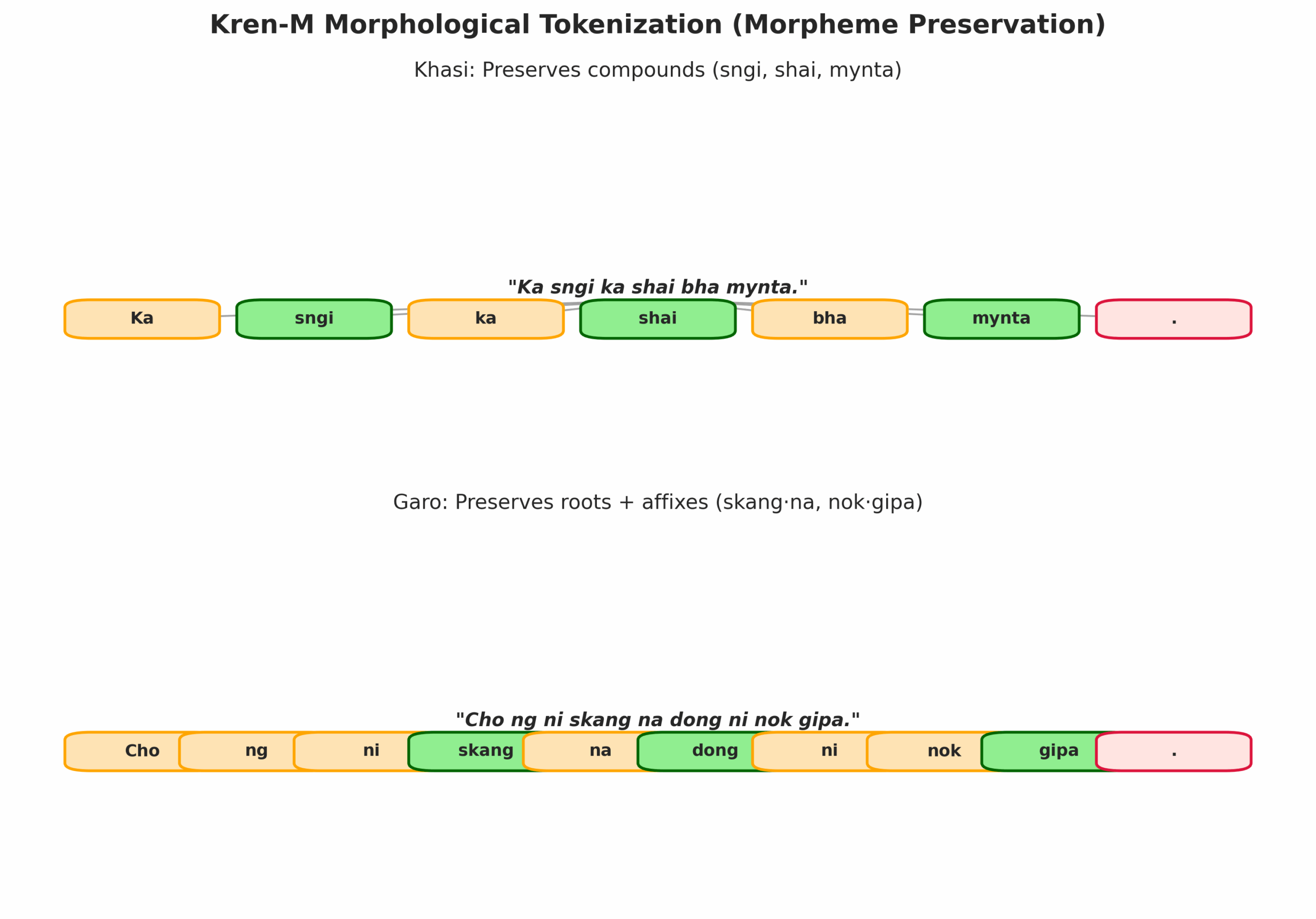
We trained a specialized tokenizer to fix over-segmentation:

  • 66,188 sentences (Khasi + Garo)
  • 5,000-token SentencePiece model
  • 2,135 new tokens added to Gemma’s base vocabulary
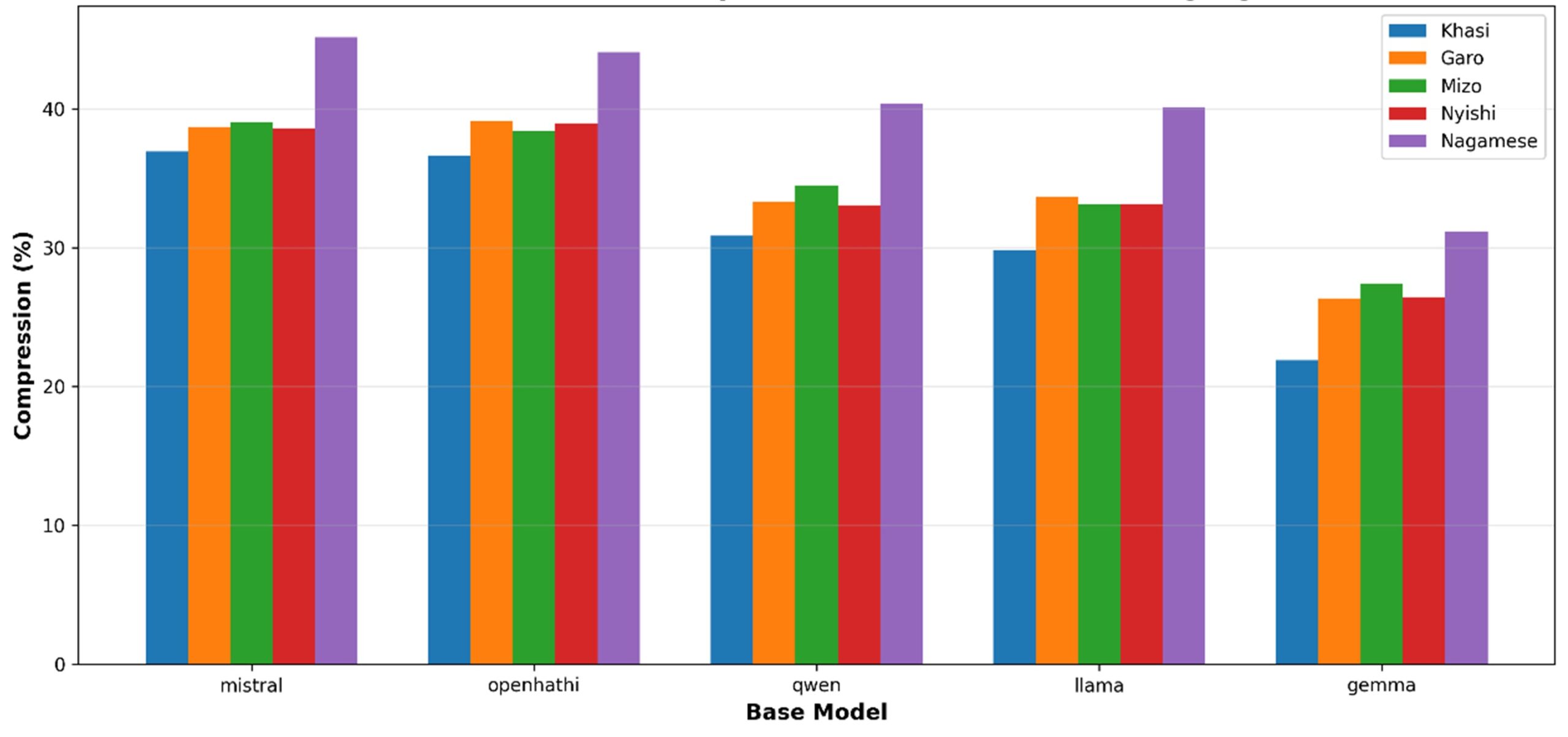
  • 30–36% fewer tokens per Khasi/Garo sentence
  • Accuracy improves because the model sees complete Khasi/Garo morphemes
Kren-NE Tokenizer (New!)

MWire Labs now maintains Kren-NE, an expanding tokenizer project covering:

  • Khasi
  • Garo
  • Mizo
  • Assamese
  • Manipuri (Meitei)
  • Nagamese
  • Nyishi

This positions Kren-NE as the first multi-language tokenizer for Northeast India, enabling future models beyond Kren-M.
2. Continued Pre-Training (CPT) — Clean Data First

We curated the largest Khasi text corpus to date:

  • 5,433,041 sentences
  • Removed HTML noise, verse citations, ellipses, auto-generated spam, mixed-script anomalies
  • Two-stage CPT:
    • Stage 1 (LR 2e-4): Validation loss → 2.974 (from 6.77 baseline)
    • Stage 2 (LR 1e-4): Minor refinement

Result:
45.5% improvement in validation loss
Fluent Khasi generation with minimal artifacts.

3. Supervised Fine-Tuning (SFT)

We built a highly selective bilingual dataset:

  • 10,097 Khasi translation pairs
  • 15,000 English Dolly-style instruction pairs
  • 7,937 Khasi conversational pairs

Critical fixes:

  • Removed 9,903 implicit translations
  • Implemented response-only loss masking
  • Enforced EOS token at every sample
  • Trained embed_tokens + lm_head for new vocabulary activation

Final SFT model loss: 0.85

Evaluation & Examples

Even without heavy RLHF, Kren-M performs strongly:

Khasi Chat (Native Fluency)

				
					User: Kumno phi long?
Kren-M: Nga biang. Phi kumno?

English Chat (No auto-translation)

User: “I need help with my homework.”
Kren-M: “Sure! What subject are you working on?”

Khasi Translation

Input: “Translate to Khasi: How are you?”
Output: Kumno phi long?


Why Kren-M Matters for Meghalaya

Transforming Digital Services

  • Government communication assistants
  • Local-language chatbots for departments
  • Automatic Khasi summarization for public-policy documents
  • Tourism chatbots for Shillong / Sohra
  • Agricultural advisory chatbots in Khasi
  • Local support centers, BPOs, helplines

Empowering Businesses

  • Local call centers with Khasi AI agents
  • Enterprise chatbot automation
  • Custom domain fine-tuning
  • On-prem security for sensitive work

Cultural & Linguistic Preservation

Kren-M is a step toward protecting and modernizing Khasi language digitally, ensuring Indigenous languages do not get left behind.

Quick start

				
					from transformers import AutoModelForCausalLM, AutoTokenizer

model = AutoModelForCausalLM.from_pretrained("MWirelabs/Kren-M", torch_dtype="auto", device_map="auto")
tokenizer = AutoTokenizer.from_pretrained("MWirelabs/Kren-M")

prompt = "<start_of_turn>user\nTranslate to Khasi: Hello, how are you?<end_of_turn>\n<start_of_turn>model\n"
inputs = tokenizer(prompt, return_tensors="pt").to(model.device)
outputs = model.generate(**inputs, max_new_tokens=100, do_sample=False)
print(tokenizer.decode(outputs[0], skip_special_tokens=True))


Let's Build Together

Are you a researcher, developer, or part of a language community in Northeast India? We are always looking for partners to collaborate on new datasets, fine-tune models, and advance the state of regional AI.